How to Measure the ROI of AI Tooling at the Team Level (Not the Individual Level)
The 55.8% individual productivity figure answers the wrong question for an ROI decision. 59% of leaders cannot quantify AI gains: not because they are not measuring, but because they are measuring at the wrong level.
Akshay Saraswat
Founder, Evols
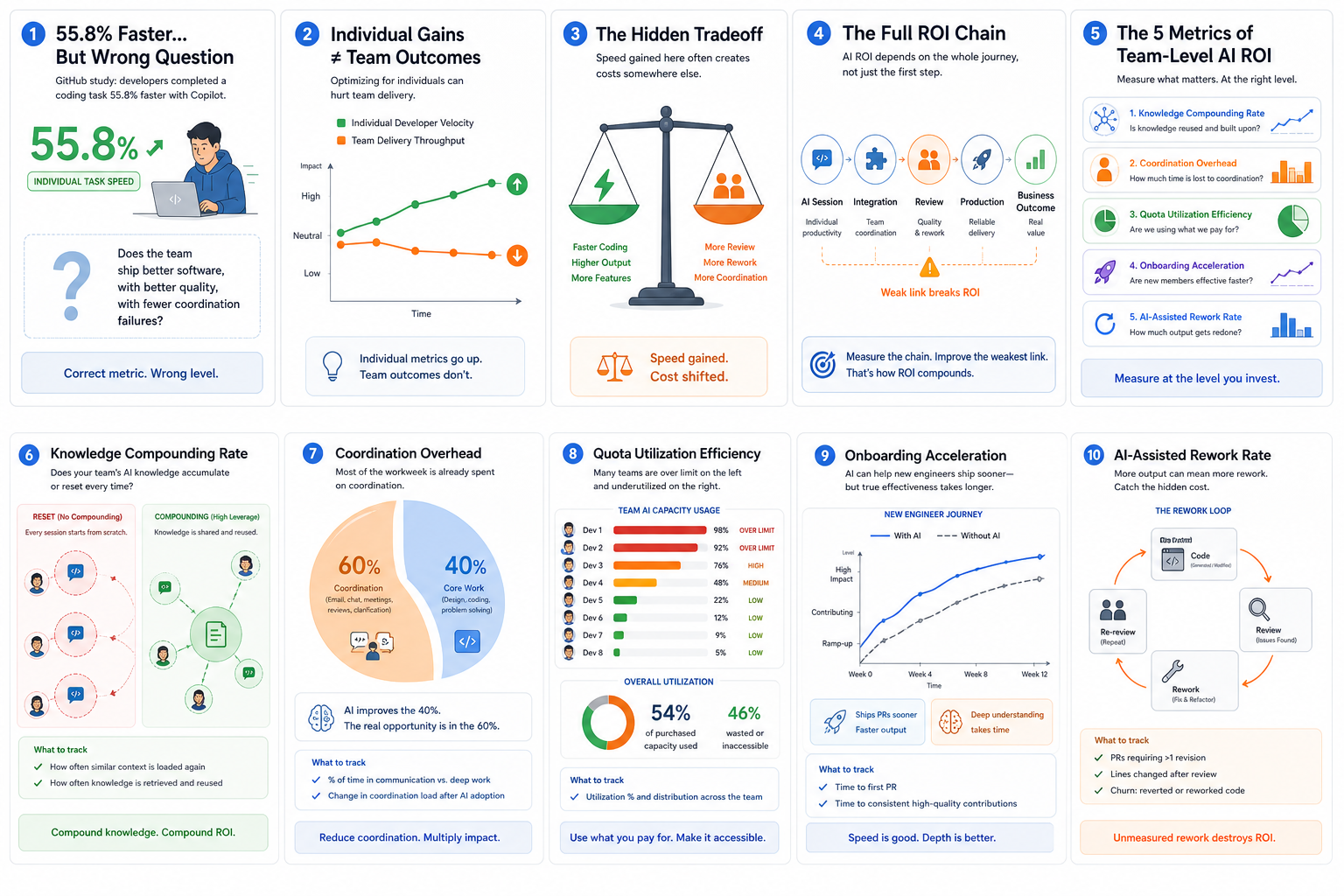
GitHub's most-cited productivity study found that developers with Copilot access completed a specific coding task 55.8% faster than those without. This number has appeared in hundreds of ROI justification documents, board presentations, and procurement decisions. It is methodologically sound for what it measured: 95 developers, a single JavaScript task, a controlled experimental design.
It is also almost completely useless for evaluating whether your AI tooling investment is producing value for your team.
This is not a criticism of GitHub's research. It's a structural critique of individual-level productivity metrics applied to team-level investment decisions.
The 55.8% figure answers: "Does this tool help an individual developer complete a defined, bounded task faster under controlled conditions?" Your ROI decision requires an answer to a different question: "Is our team shipping more valuable software, with better quality, with fewer coordination failures, as a result of this investment?" These questions have different answers, and measuring one does not tell you about the other.
The Microsoft 2024 Work Trend Index, surveying 31,000 knowledge workers, found that 59% of leaders cannot quantify productivity gains from their AI investments. They're not failing because they're not measuring. They're failing because they're measuring at the wrong level.
Why Individual-Level Measurement Understates (and Sometimes Mislabels) AI ROI
The problem runs deeper than just choosing the wrong metrics. Individual-level measurement can show positive results while team-level outcomes are neutral or negative.
The DORA 2024 report, one of the most methodologically rigorous ongoing studies of software delivery performance, found that AI tool adoption "significantly increases individual productivity, flow, and job satisfaction" while simultaneously "negatively impacting software delivery stability and throughput." Individual metrics went up. Team delivery metrics went sideways.
This isn't paradoxical: it's predictable. When individual developers work faster but with less coordination, they produce more output that conflicts at integration time. Review overhead increases. Code churn increases. The speed gains for individuals translate into coordination costs at the team level that partially or fully offset the individual savings.
The GitClear longitudinal analysis (2023–2024) found that AI-assisted code churn (lines of code reverted or substantially updated within two weeks of authoring) was on track to double in 2024 compared to pre-AI baselines. Research by Xu et al. (arXiv:2510.10165) found that after Copilot adoption, experienced core developers reviewed 6.5% more code while their own original coding productivity dropped by 19%. More output is being produced; more of that output requires correction.
Measuring "developer velocity" without measuring downstream review and rework costs produces an ROI picture that is systematically optimistic. The full accounting includes the costs that individual metrics leave out.
A Framework for Team-Level AI ROI
A team-level ROI measurement framework needs metrics that capture value creation and cost at the right unit of analysis. Five metrics form the core:
Metric 1: Knowledge Compounding Rate
Definition: How much reusable context does each AI session generate that is available to future sessions, expressed as a ratio of retrieval events to creation events?
The underlying question: is your team's AI investment compounding, or resetting? A team where session knowledge persists and is reused is getting compound value from its AI investment. A team where every session starts from scratch is getting simple value: the session is valuable, but it doesn't make the next session more valuable.
Proxy measurement: Track how often developers ask questions in standup or Slack that indicate they're reconstructing context a teammate already built. Count the instances in retrospectives where someone says "we already figured that out." These are signals that knowledge compounding is failing.
A more rigorous version: track how often similar context is being loaded into AI sessions repeatedly versus how often it's retrieved from a shared source. The gap between these two figures is the compounding opportunity.
Metric 2: Coordination Overhead
Definition: The cost (in developer time) of integrating AI-assisted individual work into coherent team output.
The research baseline: developers already spend 60% of their time on communication and coordination rather than core work (Microsoft 2024). The question for AI tooling is whether that ratio improves or worsens with AI adoption. Given the DORA finding that team-level delivery metrics decline while individual metrics improve, the hypothesis is that coordination overhead increases with AI adoption in most teams.
Proxy measurement: Review cycle length and revision count per PR. The number of synchronous conversations required to clarify work that was done asynchronously with AI. The frequency of "almost right but needs significant rework" feedback in code review.
This metric is uncomfortable to measure because it can show that AI tool adoption is creating overhead, not reducing it. But if that's what's happening, it's better to know it than to ignore it.
Metric 3: Quota Utilization Rate
Definition: The percentage of the team's purchased AI capacity that converts into productive output, accounting for limits hit by heavy users and capacity expired by light users.
The research baseline: approximately 30% of developers hit usage limits regularly (Pragmatic Engineer, April 2026). If those developers are concentrated among the team's heavy users (the people doing the most complex work), the impact on valuable output is disproportionate to the percentage.
Measurement: Track the delta between allocated capacity per day and capacity consumed per day across the team. Track how many sessions end prematurely due to rate limits versus natural completion. Track how much capacity expires unused. The gap between theoretical capacity and effective capacity is the utilization rate.
A team with 50% quota utilization (some developers hitting limits, others expiring capacity unused) is getting half the value from its AI subscription that good utilization management could provide.
Metric 4: Onboarding Acceleration
Definition: The time delta between a new hire's join date and the date when their AI-assisted work quality is indistinguishable from an experienced teammate's, compared to historical baseline.
The research baseline: The DX analysis covering developer ramp-up found that time to 10th merged PR dropped from ~67 days in 2024 to ~33 days in 2026 for daily AI users. But the same research flagged that this metric doesn't capture depth of understanding; getting code merged faster is not the same as producing the quality of work that 12 months of organizational context enables.
Measurement: Compare the code review pass rate (first-pass approval without substantive change requests) for new developers in their first three months against the same metric for developers with 12+ months tenure. The gap is a proxy for the quality penalty of the onboarding cold start. If AI tools are genuinely accelerating onboarding at the knowledge level, not just the output level, this gap should be shrinking over time.
Metric 5: Rework Rate
Definition: The percentage of AI-assisted work that requires substantial revision before it meets the team's standards, and the associated cost.
The research baseline: The Xu et al. study found that after AI tool adoption, code requires more rework to satisfy repository standards, even as individual output volume increases. The GitClear analysis found code churn (an indicator of rework) on track to double compared to pre-AI baselines.
Measurement: Track the rate at which PRs require major revisions (defined as more than X comments or Y rounds of review, calibrated to your team's norms). Compare the AI-assisted work rework rate against the non-AI-assisted baseline if you have one. If the rework rate is increasing with AI adoption, the speed gains from individual productivity are being partially offset by rework costs that don't appear in individual metrics.
How to Collect These Metrics Without Building a Data Engineering Project
The full versions of these metrics require tooling that most teams don't have. Practical starting points:
For Knowledge Compounding Rate: Run a 30-day experiment. Ask developers to log, at the end of each work week, one instance where they found context a teammate had built (via documentation, a shared artifact, or conversation) that saved them time, and one instance where they had to rebuild context they believe a teammate had already developed. The ratio of found-to-rebuilt instances is your proxy metric. It's imperfect and self-reported, but it will tell you whether the number is close to 1 (every instance of rebuilt context has a corresponding found instance, which is good) or much lower (significant compounding opportunity being lost).
For Coordination Overhead: Extract PR review data from your version control system. Calculate: average number of review rounds per PR, average time from first review submission to merge, and rate of "changes requested" in first review versus "approved." Track these weekly and look for trend changes after AI tool rollout. If you deployed AI tools at a specific date, a before/after comparison is possible.
For Quota Utilization Rate: Most enterprise AI platforms offer usage analytics through admin consoles. Pull per-developer daily usage data. Calculate daily utilization rate as consumed/allocated. Identify the standard deviation; high variance means some developers are hitting limits while others are expiring capacity. The standard deviation is as important as the mean.
For Onboarding Acceleration: Use your code review history. Pull the first 90 days of PR activity for developers hired before and after AI tool adoption. Compare pass rates, revision counts, and time-to-merge for those cohorts. This is a retrospective analysis that uses data you already have.
For Rework Rate: Label PRs where the review required substantive architectural or logic changes versus cosmetic changes. Track the ratio over time. Most code review tools allow you to filter by comment type or volume, which gives a rough proxy.
Common Measurement Mistakes
Attribution confusion. "The developer used AI and the feature shipped faster, therefore AI caused the speed." Correlation in individual cases is not causation at the aggregate level. A developer who is skilled, working on a familiar problem, with good requirements, will be fast regardless of AI tooling. Before attributing outcomes to AI, establish baseline productivity metrics for the same developers on similar work before AI adoption.
Survivorship bias in productivity reports. Teams report success stories. They rarely report sessions where the AI produced something that looked right, passed review, and created problems downstream. Measure rework rates and downstream defect rates, not just completion speeds.
The "we don't measure what we don't value" trap. Teams that build their AI ROI case entirely on individual speed metrics have, implicitly, decided that coordination overhead, knowledge compounding, and onboarding quality don't matter. This decision usually isn't made explicitly; it happens by default when the measurement infrastructure is built to track what's easy to track. The most important ROI drivers are often the hardest to measure; that doesn't make them less important.
Connecting Team AI ROI to Business Outcomes
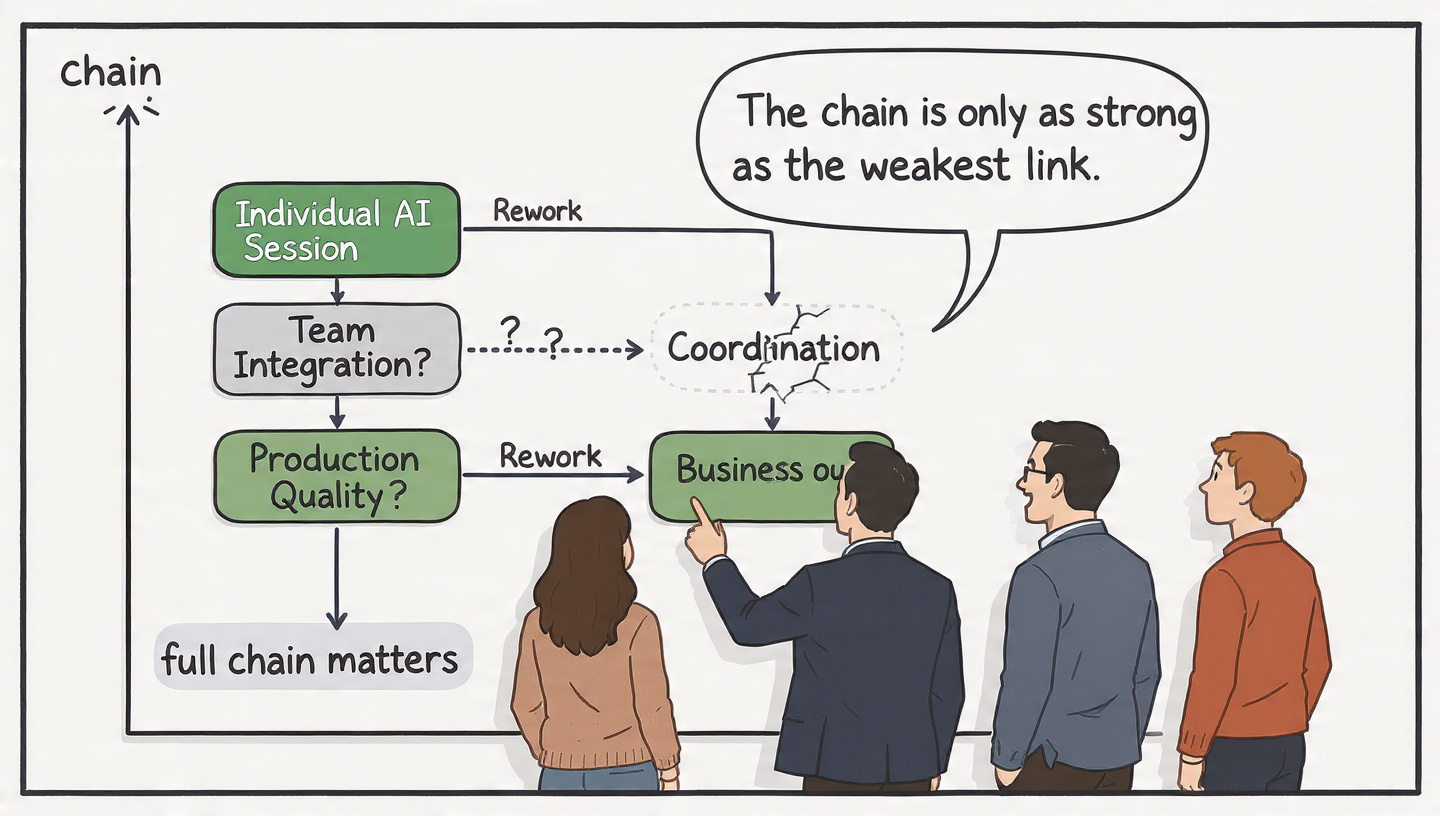
The chain from session productivity to shipping better software faster is not automatic. It requires each link in the chain to work:
Individual AI sessions produce higher-quality, more contextually appropriate output (requires good session quality, which requires context). That output integrates smoothly with teammates' work (requires coordination that prevents conflict). The integrated work passes review without significant rework (requires that AI output quality holds under review scrutiny). The shipped software performs correctly in production (requires that AI-assisted logic is correct, not just plausible-looking).
If any of these links is weak, the speed gains in AI sessions don't translate to business outcomes. Teams that are measuring individual speed and seeing it improve but not seeing business outcomes improve should investigate each link in the chain.
The Deloitte 2026 report found that only 20% of organizations using AI have grown revenue through AI initiatives, while 74% hope to. The gap between hope and outcome is usually not a technology failure; the tools work. It's a measurement and management failure: the teams that capture business outcomes from AI are the ones that measured the full chain and managed the weak links.
What Good Looks Like
A team measuring AI ROI at the team level should be able to answer these questions with data:
- Is our team's AI-generated knowledge base growing over time, and is it being used?
- Is our coordination overhead (the time and friction of integrating AI-assisted individual work) decreasing, stable, or increasing?
- Are we using the AI capacity we're paying for, and is it distributed efficiently?
- Are new team members reaching full AI-assisted productivity faster than they did before?
- Is our code rework rate better or worse than before AI adoption?
These questions are answerable without sophisticated tooling. They require deliberate measurement and the willingness to see unflattering results alongside the flattering ones.
The teams that get the best long-term ROI from AI investment aren't the ones where every developer is the most enthusiastic user. They're the ones where AI work is designed to compound: sessions produce context that future sessions can use, where coordination overhead is measured and managed, where capacity is used efficiently, and where the chain from individual session to team outcome is tracked and optimized.
That's a management and measurement discipline, not a technology problem. The technology is ready. The measurement practice is what's missing.
Try Evols for your team
Give your team an AI that remembers your context, decisions, and product knowledge.
Get early access