The Onboarding Cold Start Problem: Why New Teammates Still Start From Zero in AI-Native Teams
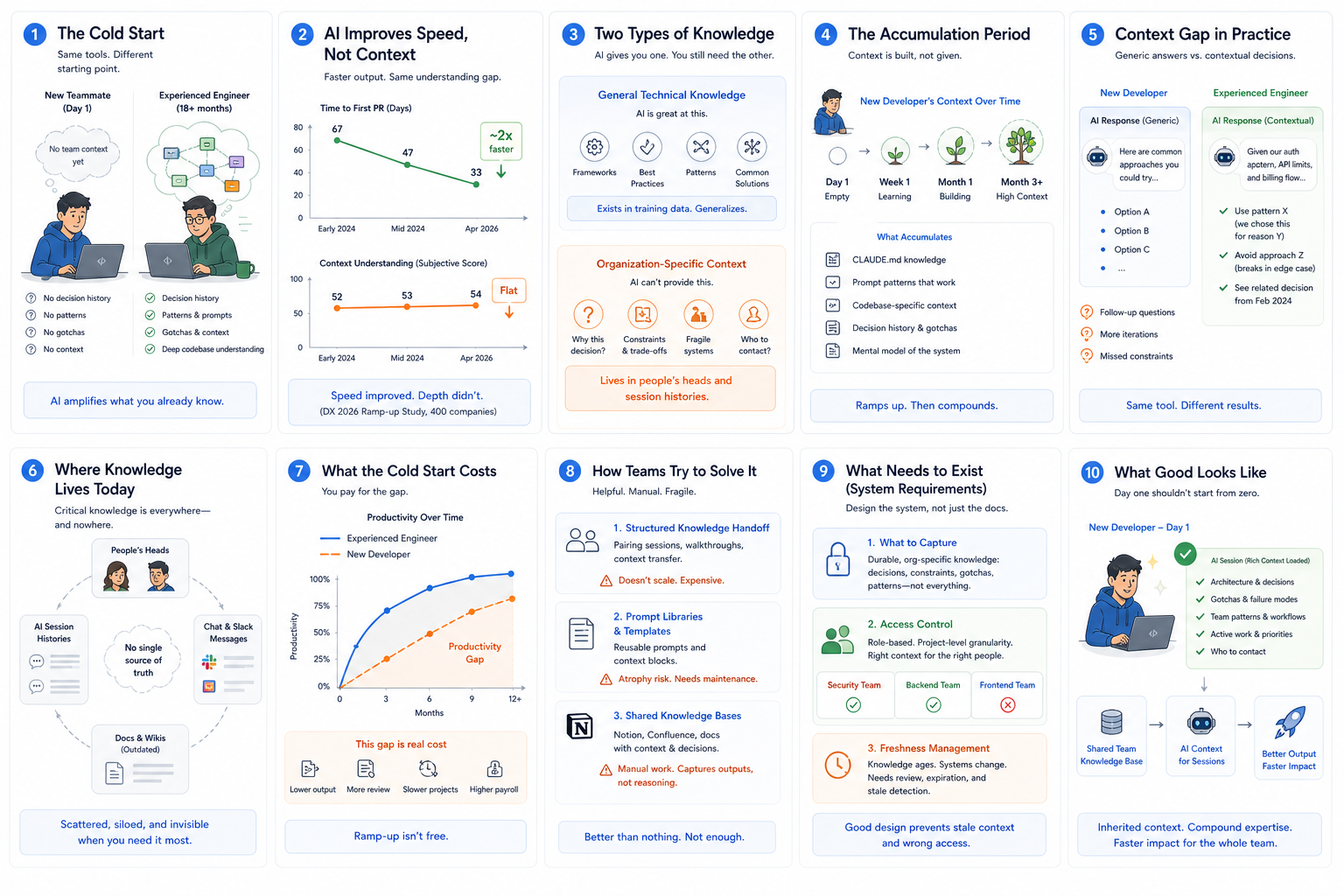
AI tools cut time-to-first-PR roughly in half for new developers, but that speed improvement coexists with a persistent context gap. The organizational knowledge that makes senior engineers effective still does not transfer.
Akshay Saraswat
Founder, Evols
In 2024, a well-known study from NBER (Brynjolfsson, Li, and Raymond, one of the more rigorous empirical analyses of AI productivity gains) found that AI tools helped novice workers improve their performance by 34%, while having minimal or slightly negative effects on top performers. The mechanism was interesting: the AI was effectively redistributing institutional knowledge from experienced workers to newer ones. The knowledge existed in the system (encoded in the model's training data from prior interactions), and the AI was making it available to people who didn't have it yet.
The finding is frequently cited as evidence that AI tools democratize expertise and accelerate onboarding. The interpretation is optimistic. The implication is mostly correct. But there's a subtlety worth dwelling on.
The knowledge being redistributed in that study was general knowledge: best practices for customer support, common approaches to typical problems. The AI could redistribute it because it was the kind of knowledge that generalizes. What AI tools in 2026 consistently fail to redistribute is the other kind of knowledge: the organization-specific, codebase-specific, decision-history-specific institutional knowledge that a senior engineer carries after 18 months on a team.
That knowledge lives in people's heads and in AI session histories that expire. When a developer joins an AI-native team, the team's general expertise is more accessible than ever. The team's specific context is as inaccessible as it has always been.
What "AI-Native Team Context" Actually Contains
The confusion about AI and onboarding comes partly from conflating two different kinds of knowledge.
General technical knowledge: how to use a framework, best practices for a programming language, common patterns for solving a class of problems. This is the kind of knowledge that AI tools are genuinely good at providing. A new developer can ask Claude to explain the authentication patterns used in modern web applications, and Claude will provide a useful answer. This knowledge is democratized. The tool is an effective substitute for the accumulated experience that previously separated senior from junior developers.
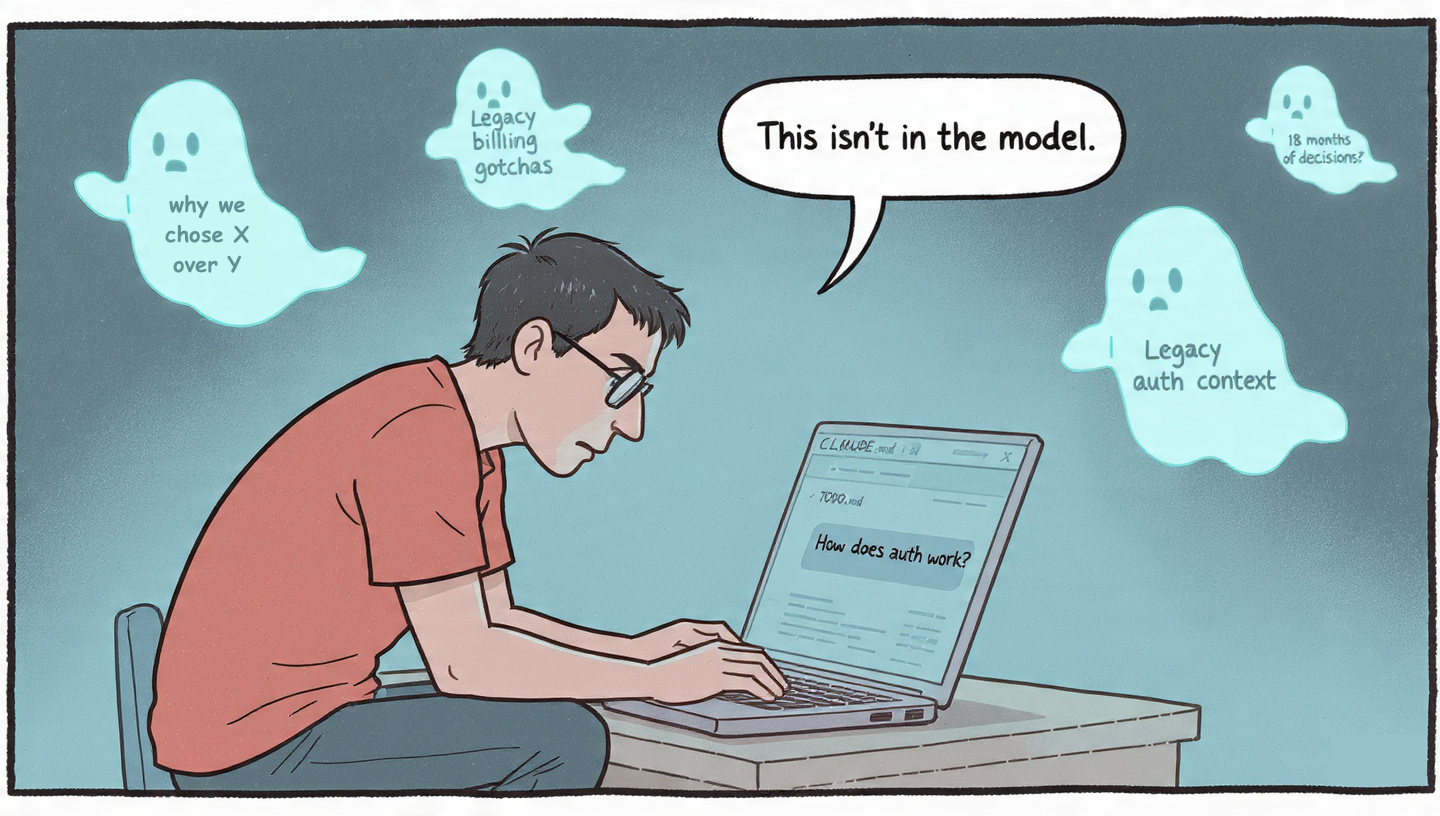
Organization-specific contextual knowledge: why this codebase uses the authentication pattern it uses, what alternatives were considered and rejected, what constraints drove the decision, which parts of the system are fragile in ways that aren't documented, who to talk to when the legacy billing service does something unexpected. This is different in kind. It doesn't exist in Claude's training data. It exists in the heads of the team members who were there when the decisions were made, and in the AI session histories from when those decisions were worked through.
When a developer who has been on a team for 18 months uses Claude Code, they bring this organizational context with them. Their sessions are grounded in 18 months of accumulated decisions. The AI is amplifying knowledge that already exists.
When a new developer joins the same team and uses the same tools, their sessions start without that context. The AI gives them the same generic-quality responses it gives everyone. The effective amplification is lower because the knowledge being amplified is less specialized.
The DX analysis tracking developer ramp-up time (April 2026, 400 companies) found that time to a developer's 10th merged PR dropped from around 67 days in early 2024 to 33 days in April 2026, roughly a 2x improvement in speed to initial output. The researchers were careful to note: "this metric doesn't capture depth of understanding." Getting code merged faster doesn't mean understanding the system. The speed improvement is real. The context gap remains.
The Accumulation Period Problem
There is a concept in AI-native development that doesn't have a standard name yet, which makes it harder to talk about: the period during which a developer is building their AI context before it becomes useful. Call it the accumulation period.
For a developer who is new to a team, the accumulation period is the time between joining and having developed enough CLAUDE.md content, enough prompt patterns, enough codebase-specific context loaded into their workflow that their AI sessions produce the quality of output that experienced teammates' sessions produce. This is distinct from general productivity onboarding; it's specifically about AI session quality.
The accumulation period varies by how much institutional knowledge has been made explicit. If a team has a well-maintained CLAUDE.md file that captures architectural decisions, gotchas, and context about the codebase, a new developer can inherit some of that context immediately. If the team has a well-curated set of past AI session summaries or decision logs, the accumulation period shortens further.
Most teams don't have these artifacts. The dominant CLAUDE.md in most teams is a sparse file that was created when the tool was first set up and hasn't been maintained since. Past AI session knowledge exists only in individual session histories.
The Gallup research on voluntary employee turnover is the best available analog for the institutional knowledge loss problem: the annual cost to U.S. businesses from voluntary turnover is approximately $1 trillion, with the loss of tacit knowledge being a primary driver. Organizations have always struggled to capture the knowledge that lives in people's heads. AI tools have created a new category of that problem: the knowledge that lives in people's AI sessions.
What the Cold Start Actually Costs
Building a rough estimate requires some assumptions about what a developer's AI session quality looks like without organizational context versus with it.
A developer who has been on a team for 12 months has, over that time, accumulated a working set of codebase-specific prompts, patterns, and context files. Their AI sessions for typical development tasks are grounded in this context. The AI's responses are specific to this codebase, this architecture, these constraints.
A developer who joined three weeks ago is running generically good AI sessions. The AI helps them, but it helps them the way it would help anyone asking similar questions, without the specificity that comes from organizational context.
The difference in session quality is hard to quantify precisely, but it manifests in concrete ways: more follow-up questions required, more generic suggestions that have to be adapted to the specific codebase, more misses on constraints that experienced developers would have loaded into context automatically. The accumulated effect is that the new developer's AI-assisted work requires more iteration and more human review before it meets the team's standards.
From the employer side, the cost of a technical hire not reaching full productivity is substantial. General HR research (Gallup) pegs the replacement cost for a knowledge worker at 0.5 to 2 times annual salary, with the cost largely attributable to the ramp-up period where the person is paid full salary while producing below-full-productivity output. AI tools have shortened this period for general technical productivity. They haven't shortened it for organization-specific AI effectiveness.
How Leading Teams Are Addressing This
The teams doing the best job at reducing the onboarding cold start have typically found one of three approaches, each with real limitations.
Structured knowledge handoff sessions. Pair programming or knowledge transfer sessions where an experienced developer walks a new hire through the team's AI workflow: the CLAUDE.md file, the context patterns, the prompts that work well for common tasks. This is effective and is the fastest way to transfer tacit AI workflow knowledge. It is also expensive: it requires senior developer time and doesn't scale beyond individual hiring events.
Documented prompt libraries and context templates. Teams that maintain a repository of high-value prompts and context templates can give new developers a head start. "When working on authentication, start with this context block" dramatically reduces the time to useful AI sessions for common task types. The limitation is maintenance: prompt libraries atrophy as the codebase changes, and keeping them current requires discipline that is hard to sustain.
Shared knowledge base approaches. Some teams maintain Notion or Confluence spaces with architectural decision records, debugging playbooks, and codebase context documents. These can be loaded into AI context at session start. The limitation is the same one that affects all documentation: it requires manual maintenance, it captures outputs not reasoning, and it doesn't automatically update when the relevant decisions evolve.
Each of these approaches represents genuine effort by teams trying to solve a real problem with the tools available. Each requires deliberate process investment on top of the tooling.
The Architectural Requirements for Solving This Systematically
A systematic solution to the cold start problem requires answers to three questions that current tools don't address.
What needs to be captured? Not everything in an AI session is worth preserving for future developers. The key signal is whether the knowledge is organization-specific and durable: architectural decisions, debugging insights for system-specific issues, constraint documentation, established patterns for this particular codebase. Generic implementation help doesn't need to be captured; the next developer can ask Claude for the same thing. The organization-specific context does.
How does access control work? A new developer on the frontend team shouldn't automatically receive context from AI sessions in the security-sensitive backend services. A contractor shouldn't have access to strategic context from the product team. The right access model is probably role-based, with project-level granularity, similar to how code repository permissions work, applied to knowledge artifacts.
How does freshness get managed? An architectural decision that was made in 2024 for a 100,000-user system may be incorrect guidance for a 10 million-user system in 2026. Knowledge that persists without expiration or review becomes a liability. Any systematic solution requires a freshness model: knowledge that ages out, knowledge that gets reviewed and updated, knowledge that is flagged as potentially stale when the relevant codebase section changes significantly.
These are not research problems. They are design problems. The decisions that answer them determine whether the resulting system actually accelerates onboarding or just creates a new category of stale documentation.
What Day-One Productivity Actually Requires
The minimum viable context for a new developer to operate with AI-assisted productivity from day one (not at senior-developer level, but without the empty-context penalty) includes:
The codebase's primary architectural decisions and the constraints that drove them. What would a developer ask Claude about this codebase in their first week? The answers to those questions should be in their context from day one.
The known failure modes and their symptoms. The authentication service behavior under specific load conditions. The reason the billing service has to be called in a particular order. The tests that take 20 minutes and the tests that break intermittently, and why.
The team's established patterns for common tasks. Not generic best practices: the specific patterns this team uses for code review, for PR descriptions, for writing tests in this codebase.
The list of what's actively being worked on. So that the new developer's AI sessions are aware of parallel work and can avoid collision rather than causing it.
None of this is exotic knowledge. Every experienced developer on the team has it. The challenge is that it lives entirely in people's heads and in their AI session histories, with no mechanism for structured inheritance by new team members.
That mechanism is what determines whether a team compounds its AI investment over time or starts over with every new hire.
Try Evols for your team
Give your team an AI that remembers your context, decisions, and product knowledge.
Get early access